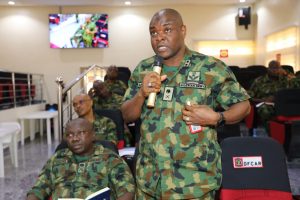
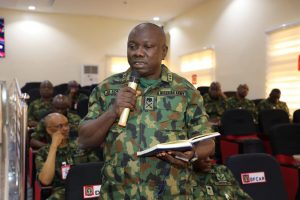
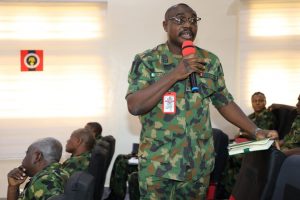
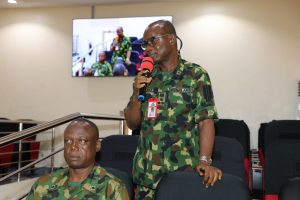
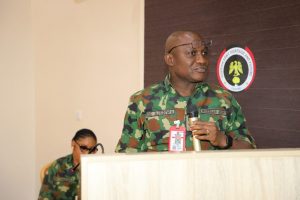
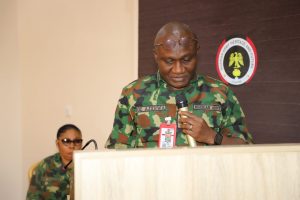
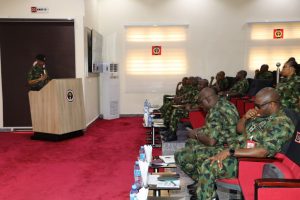
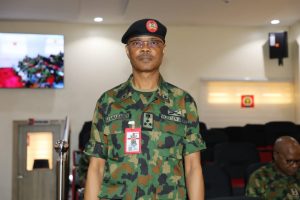
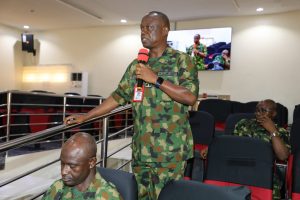
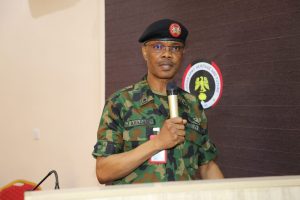
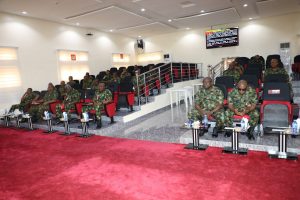
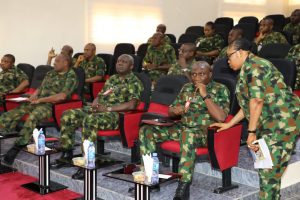
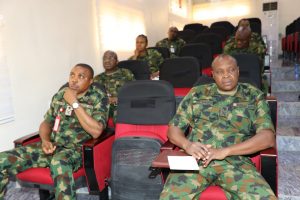
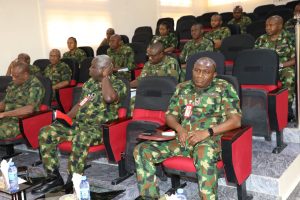
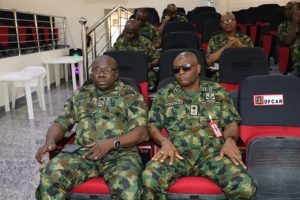
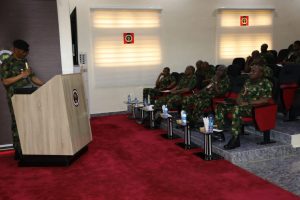
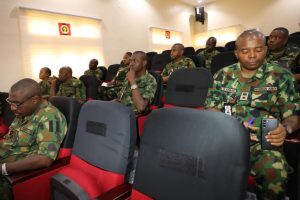
The Nigerian Army Heritage and Future Centre (NAHFC) on Thursday, 3 August 2023 hosted its routine lecture titled “Ukranian Crisis: Effects on Future Warfare” delivered by Brigadier General EJ Amadasun at the Centre’s Auditorium in Giri, Abuja.
In his lecture, Brigadier General EJ Amadasun asserted that Russia’s invasion of Ukraine constitutes the biggest threat to peace and security in Europe since the end of the Cold War. He noted that the justifications the President of Russia, Vladimir Putin, gave for the invasion, which was launched on February 22, 2022, included a long list of grievances which had prompted the ‘special military operation’. In particular, differences regarding the expansion of the North Atlantic Treaty Organisation (NATO) and the legitimacy of Ukraine. He noted the historic links between Russia and other neighbouring countries including Ukraine and Belarus, to name but a few. In delivering his lecture, the senior gave a historic overview of Ruso- Ukrainian relations dating back to the late 1700s. The presentation also discussed Russia’s desire for a sphere of influence akin to the US and tied the current conflict to the cold war crisis. Discussions extended to the political crisis from 2013-2014 where the then Ukranian President, Viktor Yanukovych failed to sign the EU- Ukraine association agreement kick starting protests in the country and leading to the Euromaidan protest movement and the deposition of Yanukovych. The lecture also outlined further signs of Russian aggression against Ukraine when on 27 February 2014, Russian troops annexed Crimea and later the Donbas region of Luhansk and Donetsk.
The presentation then discussed the implications of the conflict highlighting the strains on Russia’s relationship with the EU and US. It was also stated that these tensions are likely to increase further. Additionally, it was stated that the conflict will have broader ramifications for international cooperation particularly as it relates to arms control, nuclear non proliferation, energy security, counter terrorism and global economic stability among others. Russia’s war has also created new opportunities for the strengthening of relations between itself and China.
Further discussions also centred on the impact of the war on future wars. In this regard, one major takeaway was the constantly evolving nature of warfare. For one, it was argued by the presenter that capital assets no longer ensure dominance in warfare as they used to in the past. As such, bigger war fighting platforms are increasingly more vulnerable to low cost defensive systems. Additionally, drone warfare is becoming more prominent with the capacity to serve as a ‘game-changer’ for battles. The role of information in warfighting was also highlighted by the presenter who noted the effects of Russian and Ukranian propaganda machines to influence multiple target audiences domestically and internationally.
The presenter also highlighted the fact that non-state actors play a larger role than ever before. In particular, the influence of the media, think tanks and academia, religious groups, NGOs, organised crime, war militias, and the Ukrainian diaspora is pervasive and evident.
In his recommendations and lessons for Nigeria, the presenter noted that technology driven surveillance and intelligence gathering costs less in terms of men and logistics and serves as a force multiplier. Additionally, aside from foreign technology usage, the Nigerian indigenous technology community could offer digital solutions to the nation’s security woes but have been neglected. The challenge of adopting private militias is also highlighted using the example of the Wagner Group and the mutiny that had been witnessed earlier in the year. As such, allowing persons such as Asari dokubo to posture himself as a security outfit is dangerous for the overall security of the country.
In conclusion, it was recommended that the Nigerian Army should collaborate with the Ministry of Defence, Ministry of Communication, National Information Technology Development Agency (NITDA) and other public and private stakeholders to carry out research into the use of Artificial Intelligence and other technologies to aid their utility in warfare while also developing regulations for their use in the country.
It was also advised that the FG should give more critical consideration to the outsourcing of security to private ‘violence entrepreneurs’ to avoid the risk of violent non state actors rising against the state.
It was also recommended that the AHQ should direct the NAMC to adjust its curriculum to accommodate combat medics in its training school and also direct them to incorporate field care routines for its personnel.