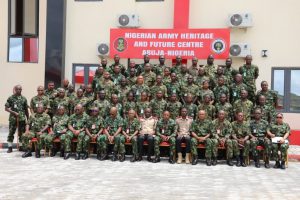
The Nigerian Army Heritage and Future Centre (NAHFC) on Monday, 25 September 2023 held a one-day sensitization workshop on the theme Defensive Driving Techniques, Road Rage and Effects of Negative Attitude to Productivity for the Nigerian Army Drivers in Giri, Abuja.
The workshop according to the Director General of NAHFC, Major General Obinna Ajunwa, who was represented by the Dean, Faculty of Military Logistics Research, Major General OM Dare, was to enhance the capabilities of Army drivers towards improved productivity.
He said, the workshop was convened to help drivers know the effects of negative attitudes on their output, apply knowledge gained to enhance performance as well as understanding negative attitudes that affect productivity.
Delivering his paper on Defensive Driving Techniques, the Chief Route Commander, also a Staff Officer, Federal Road Safety Corps (FRSC), Madu Abubakar, defined Defensive Driving as “driving to save lives, time, and money, in spite of the conditions around you and the actions of others. Abubakar said there were basic defensive driving tips that should always be followed while behind the wheels.
According to him, many drivers consider themselves as good
drivers because they have been driving vehicles for several years. “This,” he said, “is not so.
He said that in spite of experience and confidence, drivers still
make mistakes now and then, adding that mechanical faults could also occur, coupled with poor weather conditions which might contribute to cause more traffic problems, including crashes.
According to him, while some drivers are careful when driving, others are not, thereby necessitating the former to take measures to avoid crashes.
On his part, the Superintendent Route Commander, FRSC, Mr Christian Onoh, described Road Rage as aggressive or angry behaviour such as rude gestures, verbal insults, deliberately driving in an unsafe or threatening manner, or making threats. Onoh said that road rage could lead to altercations, assaults, and collisions that result in injuries and even deaths which could be thought of as an extreme case of aggressive driving.
Onoh said that the elements that could cause road rage varied. He indicated that anger, gridlock, feeling stressed, construction delays or detours, distracted driving, loud music, slow driving and making obscene gestures to other drivers were common causes.
According to him, 20 steps were arranged along a continuum of escalating degrees of hostility, beginning with relatively milder forms of aggressiveness and going all the way to extreme violence.